One-day project · Game theory + markets
IPD in Dynamic Markets
What happens when the incentives in a Prisoner’s Dilemma change along with the market?
In brief
In this one-day project with two peers, I adapted the Iterated Prisoner’s Dilemma to represent an oligopoly—a market in which a small number of players can materially affect one another. Traditional IPD simulations hold their payoff matrices constant. Our model instead let earlier cooperation, cheating, and retaliation change the incentives players encountered in later rounds, treating the market itself as dynamic.
Play a round
Choose a move and see the outcome. Tit for Tat opens by cooperating, then mirrors your previous choice.
Choose your first move to reveal the payoff.
Model inputs
| Cooperate | Defect | |
|---|---|---|
| Cooperate | 7, 7 | 2, 10 |
| Defect | 10, 2 | 3, 3 |
| Cooperate | Defect | |
|---|---|---|
| Cooperate | +0.5% | −0.2% |
| Defect | −0.2% | −0.5% |
What we did
- 01Defined four strategies: Cooperator always cooperates, Defector always defects, Random chooses either action with equal probability, and Tit for Tat mirrors its opponent’s previous move.
- 02Built a symmetric initial payoff matrix and a percent-change matrix that updated future rewards and penalties according to each round’s outcome.
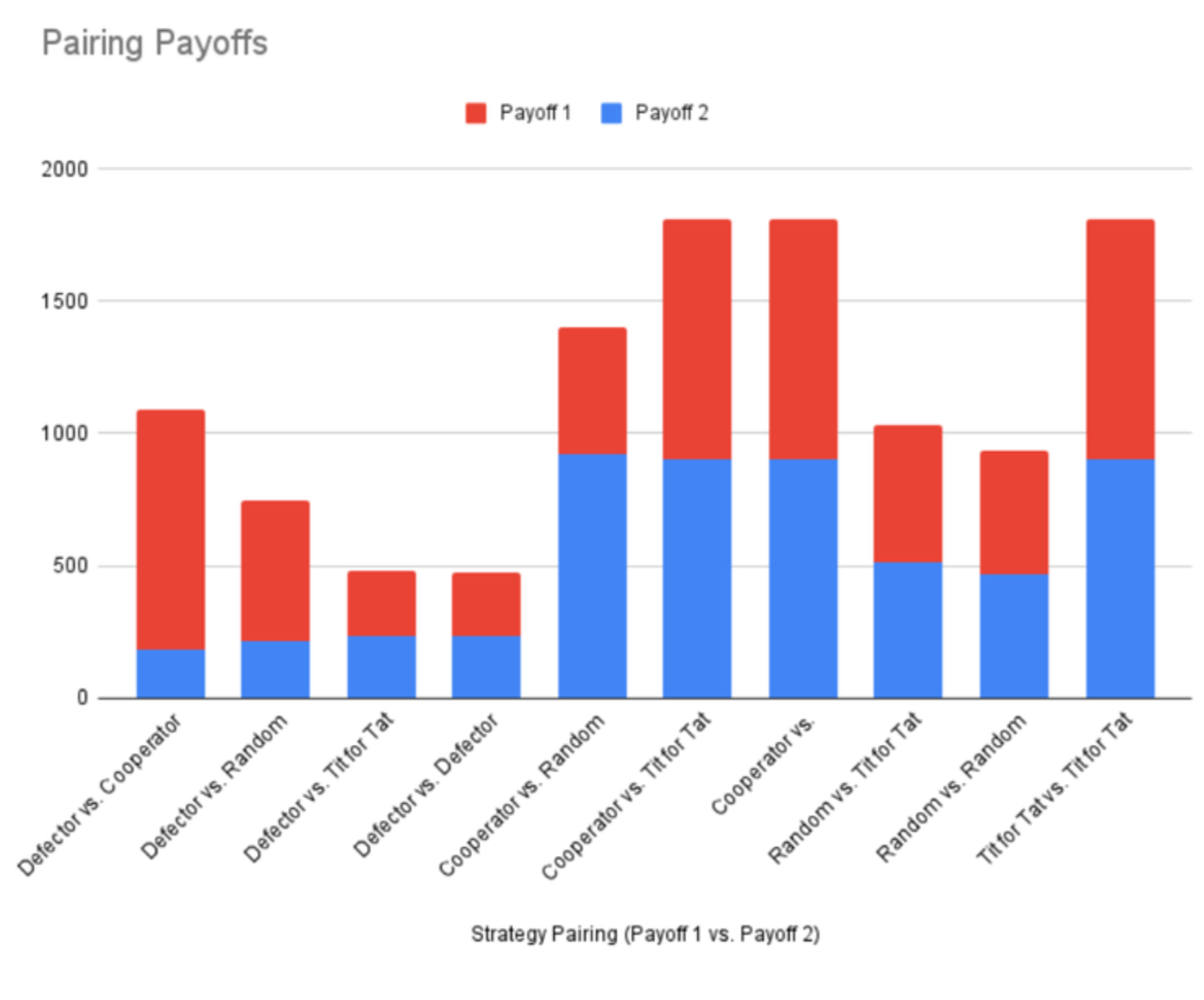
- 03Ran round-robin tournaments in which every strategy played every other strategy 100 times, allowing behavior and the changing payoff structure to influence one another.
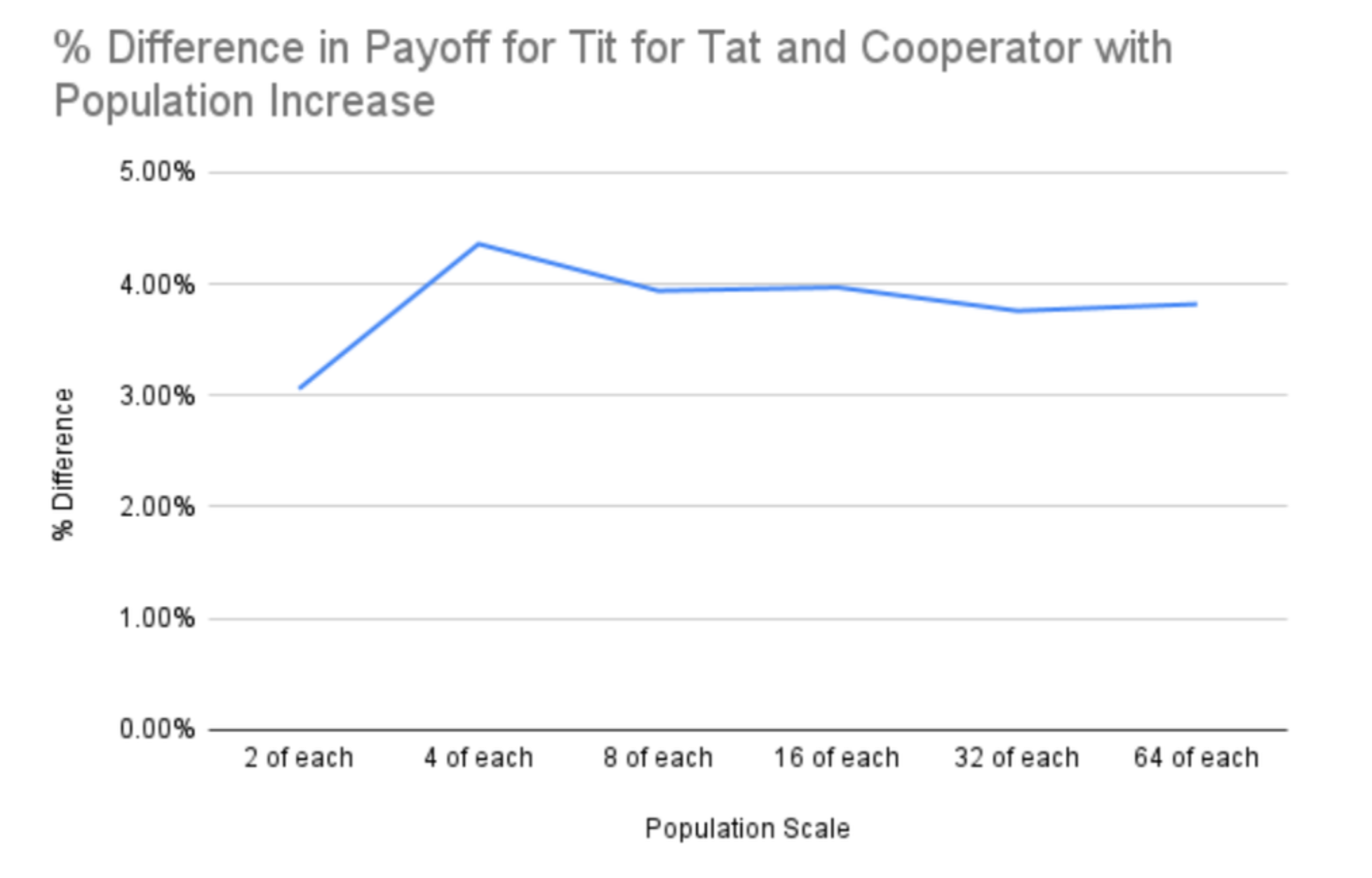
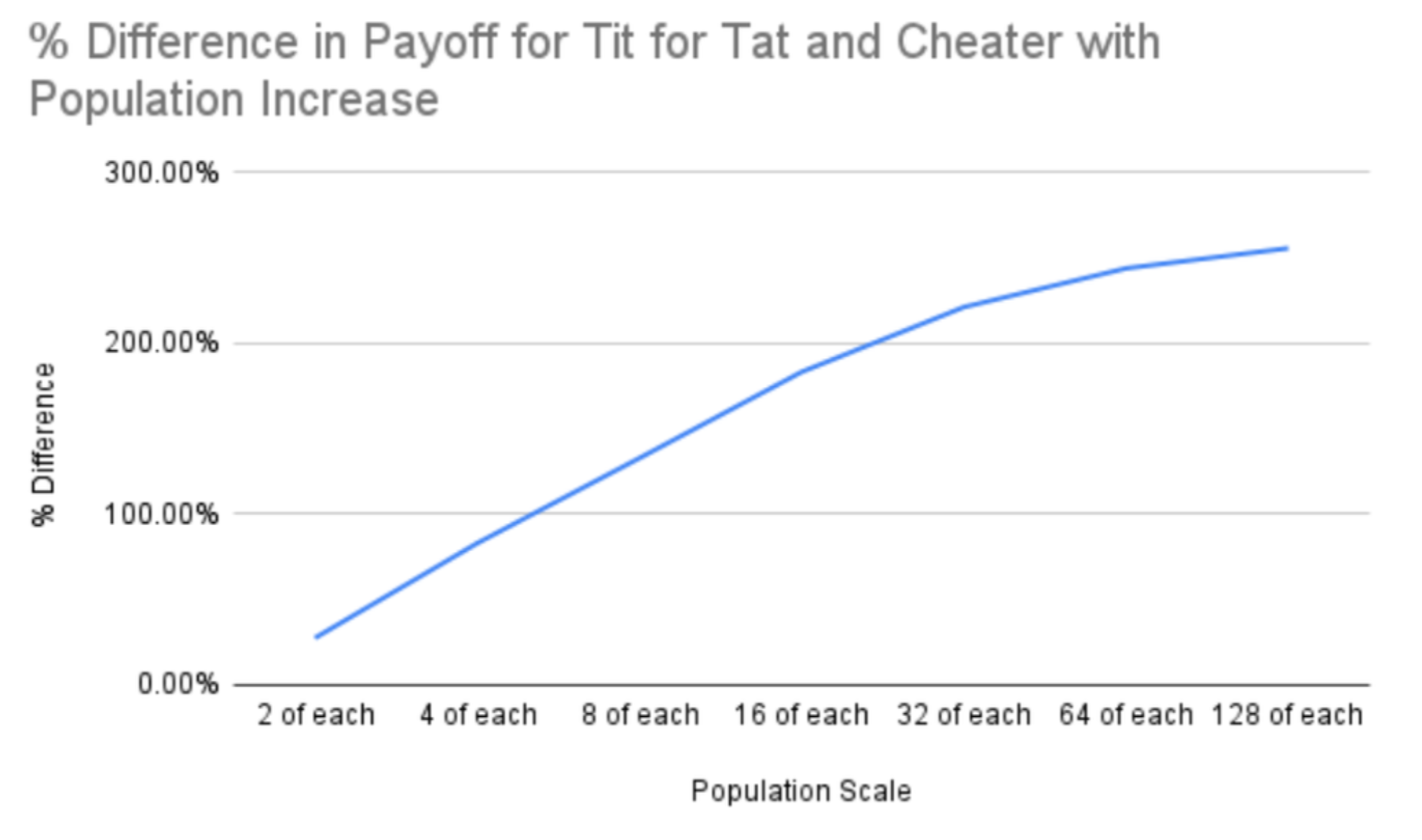
- 04Scaled the simulated population and compared total and relative payoffs, focusing on exploitation, stable cooperation, and whether adaptive strategies retained their advantage.
Key finding
Mutual cooperation produced the highest combined payoffs. Tit for Tat maintained a modest advantage over unconditional cooperation while defending itself against Defectors; most notably, its relative advantage over the non-adaptive Cheater strategy grew consistently as the simulated population increased.